Water Quality Annual Newsletter - October 2026
Water Quality Annual Newsletter - October 2026
FEATURED IN THE NEWSLETTER:
An El Niño Year: What does that mean for Northern California
GROUNDWATER:
· Outliers: What, Why, Where and How?
· Managing Groundwater with Small Farms in Mind
· CV-SALTS update
SURFACE WATER:
· Management Plan Update: Sediment Toxicity/Water Column for Pyrethroids
· Delta Regional Monitoring Plan
· Delta Mercury Monitoring
COALITION/MEMBERSHIP UPDATES:
· Farm Reporting Update
· Reporting Policy Change
· New Correspondence Method
· Membership Fees
· Financials
· Outreach Schedule
PARTNERSHIP UPDATES:
Solano RCD-
· SRCD Fall Native Plant Sale
· The "Good Fire" in Solano County
USDA NRCS-
· Federal Assistance Opportunities for Ag Producers
Board of Directors and Committee Members
An El Niño Year: What does that mean for Northern California?
El Niño will likely become very strong this fall. A very strong El Niño does make a wet winter more likely for California, but it doesn’t guarantee that’s how things will go this year. It's important we stay informed and are prepared for the possibility of flooding. Historically, outcomes are mixed. And if this winter is wet, details like the strength, timing and spacing of storms are what will determine the impacts to our day-to-day lives. That’s because El Niño is only one climate driver. Its impacts depend on a combination of other factors.
What is El Niño?
El Niño is a cyclical, long-term global weather phenomenon marked by warmer than normal ocean temperatures. It is not a single “storm” or even a “series of storms.” An El Niño pattern emerges when water temperatures in the eastern tropical Pacific Ocean are warmer than normal. At the same time, tropical trade winds get weaker. These changes in the wind and water shift where clusters of thunderstorms form. Shifts like this can ripple through the atmosphere and affect temperature and precipitation patterns in North America but also alter the flow of the jet stream. For California, El Niño’s influence tends to be most significant between late fall and winter.
How strong could this El Niño event be?
NOAA forecasters say that "strong" El Niño conditions are likely by the end of the summer. A "very strong" El Niño is now the most likely outcome this fall or early in the winter. According to NOAA's outlook released on July 9, there is an 81% chance of a very strong El Niño forming. It is possible that this year's event could become one of the strongest since 1950, when modern record-keeping began.
What happened in Northern California during previous very strong El Niño events?
Since 1950, four “very strong” El Niño events have occurred. The most powerful event in that time came during the winter of 1982-1983. Events in 1997-1998, 2015-2016 and 1991-1992 rank second through fourth. In general, the stronger an El Niño event is, the more the scales get tipped towards certain expected impacts for North America. But those impacts can still vary greatly from event to event. The 1983 and 1998 water years were very wet in Northern California. Sacramento, Stockton and Modesto each about doubled their typical rainfall. Both years had damaging flooding. Snowfall was well above normal. But the water year of 1992 looked very different. Northern California was relatively dry. Snowfall was just 66% of normal at the UC Berkeley Central Sierra Snow Lab. For comparison, this past winter's snowfall at the lab site was 85% of normal. A “very strong” El Niño pattern does tip the odds in favor of a wet winter in this area, but it is not a guarantee. Even then, it will be the day-to-day weather and timing of any strong storms that determine the overall course of this coming winter. These are details that can only start to come into view a couple of weeks before they happen.
Why do El Niño impacts vary?
The winters of 1983 and 1998 have made El Niño synonymous with powerful storms and damaging floods for Northern California. Because of this, El Niño now makes a lot of headlines, and it grabs a lot of attention on social media platforms. But it is important to remember that El Niño is one major climate driver, but it is not the only one. The Pacific-North American pattern influences where troughs of low pressure and ridges of high pressure set up. The Arctic Oscillation affects the shape of the jet stream and how easily Arctic air can drop into the lower latitudes. The Pacific Decadal Oscillation is like El Niño but on a much longer timescale, and the area of focus is the north Pacific Ocean. Long-range forecast experts at NOAA consider all of these factors when creating a seasonal temperature and precipitation outlook.
Article Sources: KCRA Article, July 9, 2026 and NOAA website
Learn more and stay up-to-date:
- NOAA-Guide for El Niño in CA
El Niño in California: Information & Preparedness Guide, NOAA
- National Weather Service El Niño Update for September 24, 2026
NOAA-National Weather Service-El Niño Update
- Weather West Website presented by Dr. Daniel Swain
Weather West-California Weather and Climate Perspectives
- Sustainable Conservation presents a webinar
"El Nino explained" featuring Dr. Daniel Swain
Groundwater:
Outliers: What, Why, Where and How?
Where can I find the Grower Feedback Reports?
In December 2025, the 2024 Crop Year Irrigation and Nitrogen Management Plan Summary Report Results were made available to Coalition members in our online DMT- data management tool. Members should log into their account and select "Grower Feedback Reports" in the lower left menu to view and download their 2024 and previous crop year reports from the DMT.

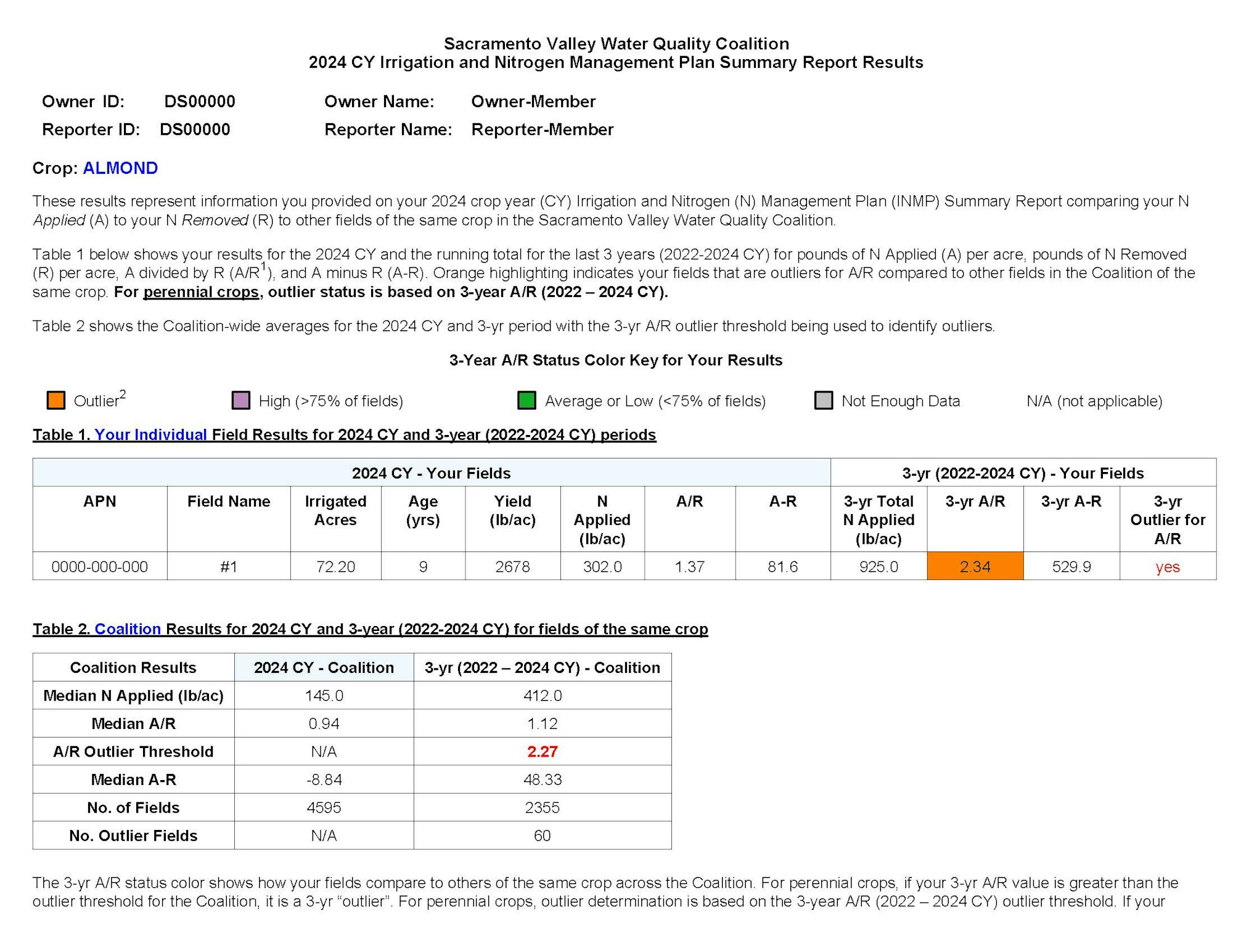
The report results represent information you provided on your 2024 crop year Irrigation and Nitrogen Management Plan Summary Report (INMPSR). The 3-year average outliers are from the past three years of INMP Summary Reports. (2022-2024)
Sample Grower Feedback Report with a 3-yr average outlier for the Almond orchard, shows an A/R of 2.34, which is slightly above the threshold of 2.27, making the field an outlier.
Why do we collect this data?
We collect this data because it is required by the Regional Water Board. The purpose is to protect water quality by estimating how much nitrate has the potential for leaching to groundwater and to provide usable information back to growers.
What does it mean to have fields identified as outliers?
The reports compare your Nitrogen Applied (A) to your Nitrogen Removed (R), with other fields of the same crop in the Sacramento Valley Water Quality Coalition. These comparisons help you understand whether your nitrogen applications are considered Outliers, High (>75% of fields), Average or Low (<75% of fields).
What requirements are there when fields are identified as outliers?
First, check that you submitted the data correctly. Inputting a wrong number can skew the results. If your field has a 3-year average above the threshold, it is an outlier, requiring that the Irrigation and Nitrogen Management Plan be certified by a specialist such as a Certified Crop Advisor, until the parcel is no longer flagged as an outlier. Growers/operators can self-certify their plans after successfully completing the self-certification training provided by the CDFA: Irrigation and Nitrogen Management Training for Grower Self-Certification. More details can be found at this link, https://www.cdfa.ca.gov/is/ffldrs/frep/training.html. This is the same certification requirement for growers with parcels in high vulnerability areas (HVA) for nitrates, who must also have their plans certified.
How do I use this information?
Keep in mind that when your field is an outlier, it signals that you use more nitrogen than 75% of the other like-crops within the Sac-Valley. With that said, think of ways to use other resources for the health of your crops/fields. Look for nitrogen "credits" in the soil and water, use other amendments like compost, possibly plant a cover crop to boost nitrogen in the soil. Contact your CCA-certified crop advisors for more information.
Reminder:
These reports become available each year in late December for the prior crop year. Look for the 2025 grower feedback reports for review in the DMT the last week of December 2026.
Managing Groundwater with Small Farms in Mind
California’s 2014 Sustainable Groundwater Management Act (SGMA) is a necessary step toward ending decades of unsustainable groundwater pumping. Yet, as local agencies work to achieve groundwater sustainability and farms across the state adapt to new regulations, there is a growing risk that small farms face disproportionate challenges in understanding and adapting to those rules. These producers anchor rural communities, local food systems, and cultural heritage across California, while contributing the least to groundwater overdraft. Source directly from report developed in partnership by the University of California Small Farms Network and CAFF-Community Alliance with Family Farmers.
CV-SALTS: Central Valley Salinity Alternatives for Long-term Sustainability
Stay informed! Register for the CV-SALTS 2026 webinar on October 29, 2026 at 11 am for an update on the progress being made to address two of the Central Valley’s most significant water quality challenges: nitrate and salinity.
This webinar will highlight the science, collaboration, and solutions shaping the next chapter of the program. Participants will hear about key program accomplishments, progress implementing drinking water solutions, and the technical and planning work underway to develop sustainable approaches to long-term salt and nitrogen management.
Learn more: CV SALTS website
Surface Water:
Management Plan Update
Approved Management Plan IN PROGRESS:
Sediment Toxicity
Monitoring Site: Ulatis Creek at Brown Road
Crops: Alfalfa, processing tomato, barley and pear
Pesticides: Pyrethroids: Lambda-Cyhalothrin, Bifenthrin
Our Goal: Zero exceedances
Water Column
Monitoring Site: Ulatis Creek at Brown Road
Crops: Alfalfa, almond, corn (grain), dried bean, melon, processing tomato, sorghum milo, sunflower, uncultivated agriculture and walnut
Pesticides: Pyrethroids: Bifenthrin, Lambda-Cyhalothrin,
Our Goal: Zero exceedances
We have a combined sediment toxicity and water column management plan for pyrethroids in Ulatis Creek.
Addendum to Surface Water Quality Management Plan for Hyalella Azteca Toxicity in Ulatis Creek: Surface Water Quality Management Plan for Water Column Pyrethroid Pesticides in Ulatis Creek
Ulatis Crk_Hyalella Toxicity_Mgmt Plan Addendum_with Water Column 20251113
A water year (WY) runs from October 1 through September 30. We had zero pyrethroid exceedances in WY 2026 thanks to the growers using care when applying pyrethroids.
For the D/S RCD Water Quality Coalition to complete the management plan, we must continue to have zero exceedances through August 2028.
Exceedances:
Sediment toxicity exceedances:
- April 17, 2018 - Lambda-Cyhalothrin
- April 18, 2019 - Lambda-Cyhalothrin, Bifenthrin
- April 21, 2022 - DNQ*
- April 16, 2025 - DNQ*
(DNQ-Detected not quantified: Pyrethroid was detected above the water quality objective without a specific measured amount to quantify, still qualifies as an exceedance)
Water column exceedances:
- June 23, 2021 - Lambda-Cyhalothrin
- December 17, 2024 - Bifenthrin, Lambda-Cyhalothrin, Cyfluthrin, Esfenvalerate
- May 20, 2025 - Bifenthrin
Remember to proceed with caution and follow all BMP when using pesticides, particularly pyrethroids.
Best Management Practices (BMP) for Pyrethroids and Other Pesticides
- List of common pyrethroids, click here.
- BMP for Pyrethroids
- IPM-UC California

- Barn Owl Boxes: IPM-Integrated Pesticide Management
The barn owl is a farmer's free rodenticide and an excellent alternative for pest control.
Here is information about the benefits of owl boxes in agriculture where gophers, rats and voles are a problem.
Resources: Owl Box Company website
Leveraging Barn Owls to Manage Rodents in AgSolano and Dixon RCD can help landowners and growers design, find or contract with someone to build owl boxes and raptor perches. Contact us for more information.
Delta Regional Monitoring Program
History: The Delta Regional Monitoring Program (DRMP) is a stakeholder-driven collaborative initiative formed in 2014 to collect and evaluate objective, cost-effective water quality data in the Sacramento-San Joaquin Delta
The DRMP was initiated under the encouragement of the Central Valley Regional Water Quality Control Board (CVRWQCB) with the primary goal of tracking and documenting the effectiveness of beneficial use protection and restoration efforts through comprehensive monitoring of water quality.
Goal: Track regional water quality trends and conditions in the Delta. The main focus areas of the DRMP including mercury, nutrients, constituents of emerging concern and pesticides/toxicity.
Compliance: Dischargers can participate in the DRMP to satisfy regional monitoring requirements instead of conducting individual monitoring studies. The Coalition is a participant in the DRMP on behalf of the members.
For WY 2024, 99.9% (15,750 of 15,759) of the environmental results compared to a water quality metric set by the CVRWQB. A total of nine samples were reported above their respective metrics, which included results for bifenthrin, diuron, imidacloprid, and naled with dates of the event listed below.
These pesticide samples are not exceedances for our management plan, however, they are above the water quality metrics from the CVRWQCB for the DRMP and are pesticides (Bifenthrin, a pyrethroid) commonly used in agriculture.
Monitoring event dates:

NOTE:
- This table shows the nine pesticide exceedances in the Delta RMP for WY 2024.
- For imidacloprid samples in events 1 and 2, there are two exceedances in each event.
- No exceedances were found in event 5 samples.
- Naled is an organophosphate insecticide used primarily to control adult mosquitos, leaf-eating insects on a variety of fruits, vegetables, nuts and greenhouses.
Delta Mercury Monitoring
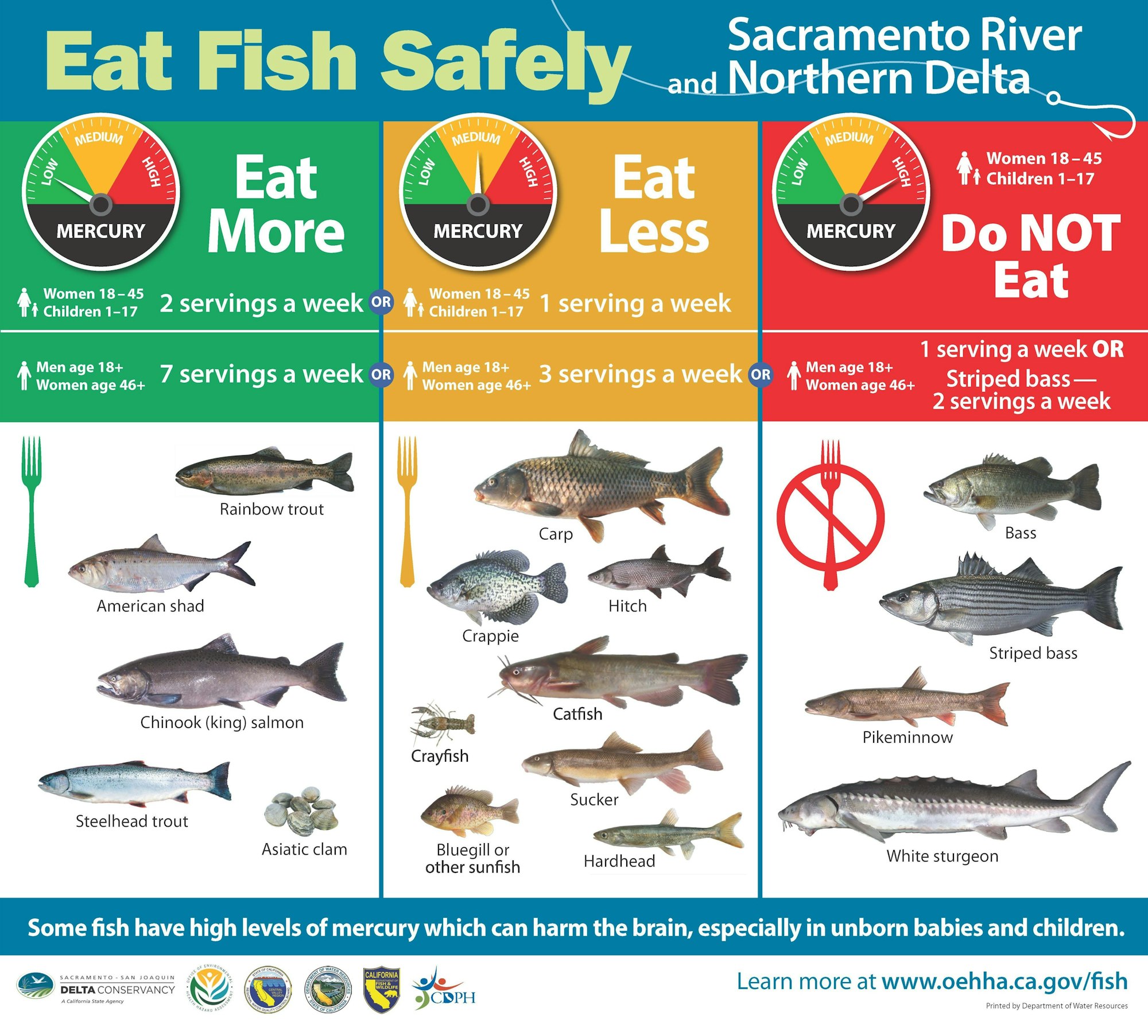
The DRMP designed and implemented a mercury monitoring program with the goals of answering priority management questions and supporting the management of Methylmercury (MeHg) Total Maximum Daily Load (TMDL) for the Delta. The design is cost-effective and is meeting goals and gathering high-quality dataset on mercury in fish and water within the Delta. Concentrations of MeHg in fish from the Sacramento–San Joaquin Delta (the Delta) exceed TMDL thresholds for protection of human and wildlife health. The results of the monitoring significantly solidified and advanced understanding of mercury impairment in the Delta. To read more about mercury in the Delta, see the fact sheet and visit the website.
Delta RMP Water Quality Website
Coalition/Membership Updates:
Farm Reporting Update
On February 15, 2026, the due date, we were at 91% complete for farm reporting. After many emails and phone calls to reporters and a handful getting Regional Board NOV-notice of violations, farm reporting for crop year 2025 wrapped up at 100% complete! This brings us to the new policy change for crop year 2026.
Reporting Policy Change
Our current policy states that we notify the Regional Board of non-reporters on the enrolled tab of the Annual Participant's list of requirements the reporter did not complete for the year. Under the new policy, we will drop the parcel from the program by adding the owner, reporter and parcel* to the dropped list. The Regional Board will begin enforcement. This will reduce local staff time while keeping costs down for members who have reported and are in good standing. If the reporter is not the parcel owner, we will notify the landowner prior to dropping the parcels from the program so they may complete the action needed.
*(Split parcels with different reporters will be kept on the enrolled tab with a notation of the missing reports for fields of the non-reporter.)
New Correspondence Method
For FY 2027, we will be sending reminders via text message for invoicing and farm reporting. We will not bombard you with an abundance of texts, just short reminders about payments and farm reporting when we are approaching the due dates, sending the texts to only members who have not paid and/or completed the annual farm reporting.
To opt out of this service, log into the DMT and go to MY INFO in the upper right-hand corner of the screen, uncheck the box "I agree to receive text messages at these phone numbers."
Membership Fees
The acreage fee remains the same at $3.75 per/irrigated acre. The budget is stable for the upcoming fiscal year therefore, increase is not warranted at this time. Budgets for FY 2026 and FY 2027 are below for review.
Financials
2025-2026 Final Budget
2025 2026 DSRCDWQC_Budget-final.pdf2026-2027 Preliminary Budget
2026 2027 DSRCDWQC_Budget-prelim.pdfMulti-year Comparison
Multi-year Comparison for WQ-05222026.pdfOutreach Schedule
- All Member Meeting:
October 21, 2026 from 5:30 pm - 6:30 pm
Coalition and Membership updates
In-person and online
RCD Conference Room 1170 N. Lincoln Street, Suite 109 Dixon, CA 95620
Join Zoom Meeting:
https://us02web.zoom.us/j/83135410981?pwd=4RjD28VkRG2rIU6vceJK3tpzv3Ee6n.1
Meeting ID: 831 3541 0981
Passcode: 261724
One tap mobile:
+16699006833,,83135410981#,,,,*261724# US (San Jose)
- Groundwater Workshop:
January 26, 2027 from 9 am – Noon
An update about Solano Groundwater Sustainability Plan (GSP) and other groundwater related topics.
Details and registration information coming soon.
In-person only
American Legion Hall 1305 N. 1st Street Dixon, CA 95620
Other events coming in early 2027:
- Local Work Group: A Partnership with NRCS to gather thoughts from local producers about priority conservation practices and NRCS programs for Solano County.
- A training video for INMP Worksheet 101: Where, when, why, who and how to complete the form. Video planned for production in both English and Spanish.
Partnership Updates:
Solano RCD-
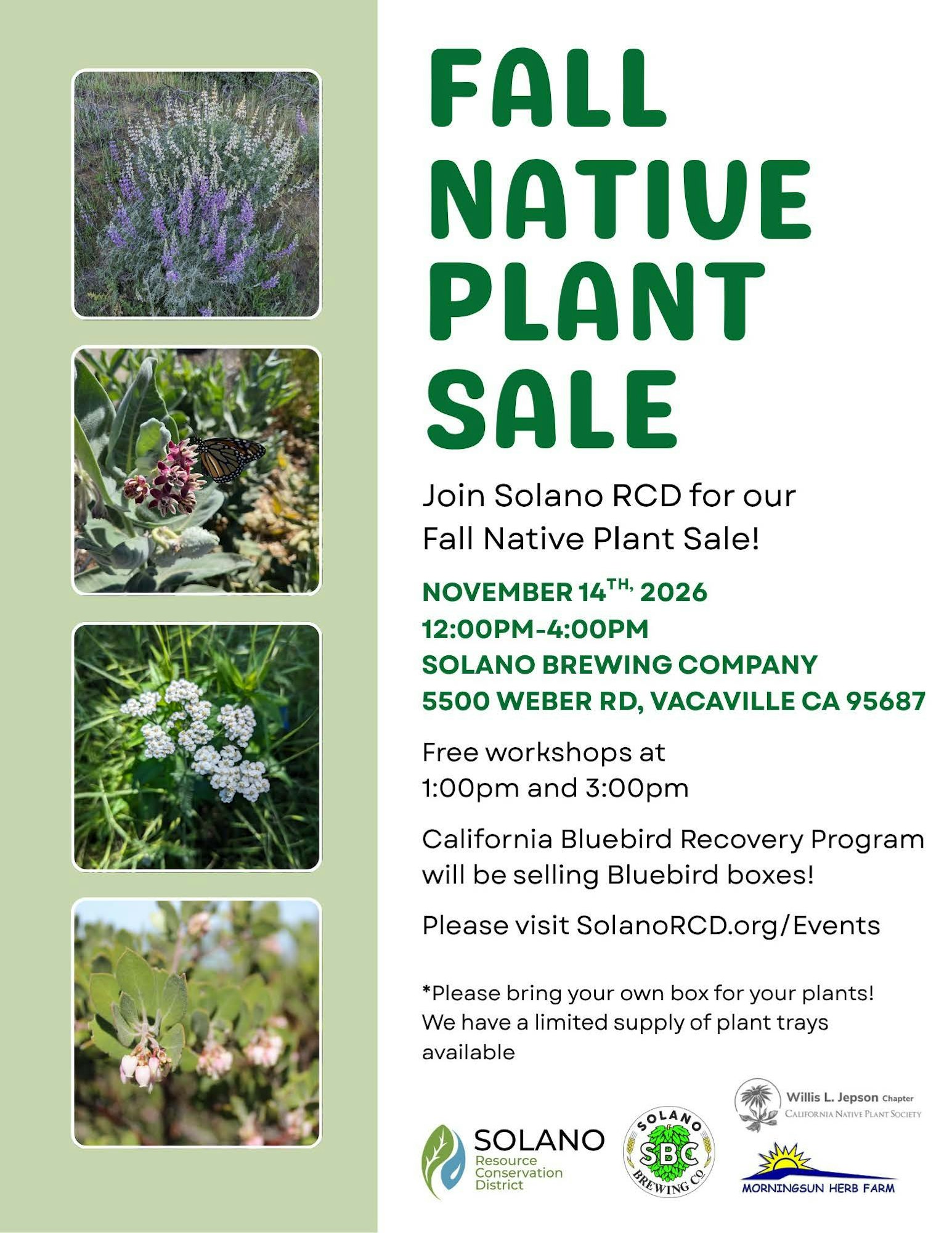
For more information about the plant sale, call (707) 678-1655 or email info@solanorcd.org
The "Good Fire" in Solano County
How do you manage the grass along your roadside? Maybe Public Works does some, maybe you do it all yourself, maybe you hire someone. Regardless of who’s doing the work, this effort looks pretty much the same: mowing, “weed whacking” or spraying. These tools work – cut the vegetation down, kill it, maybe add a pre-emergent – but are we forgetting a valuable tool in our toolbox? In our work with landowners across Solano County, the Solano RCD staff often hear some variation of “well back when I was younger, we would burn the roadsides every year!” Over the last few decades, the use of prescribed fire – or “good fire” – has decreased in lieu of other methods. But shifting away from fire means we lose one of the key benefits this tool offers: actually, removing the flammable material! Once an area is burned, the fuels are gone – so that area won’t carry fire (at least, not until the grass regrows). That’s critical when we look at patterns in fire data, and notice how many of the fires in our area start from roadside ignitions: a disabled vehicle, a dragging trailer chain, a thrown cigarette. Some fire agencies successfully use preventative roadside burns to reduce the frequency of large fires. We know it works – when used carefully, and in compliance with all applicable rules and regulations.
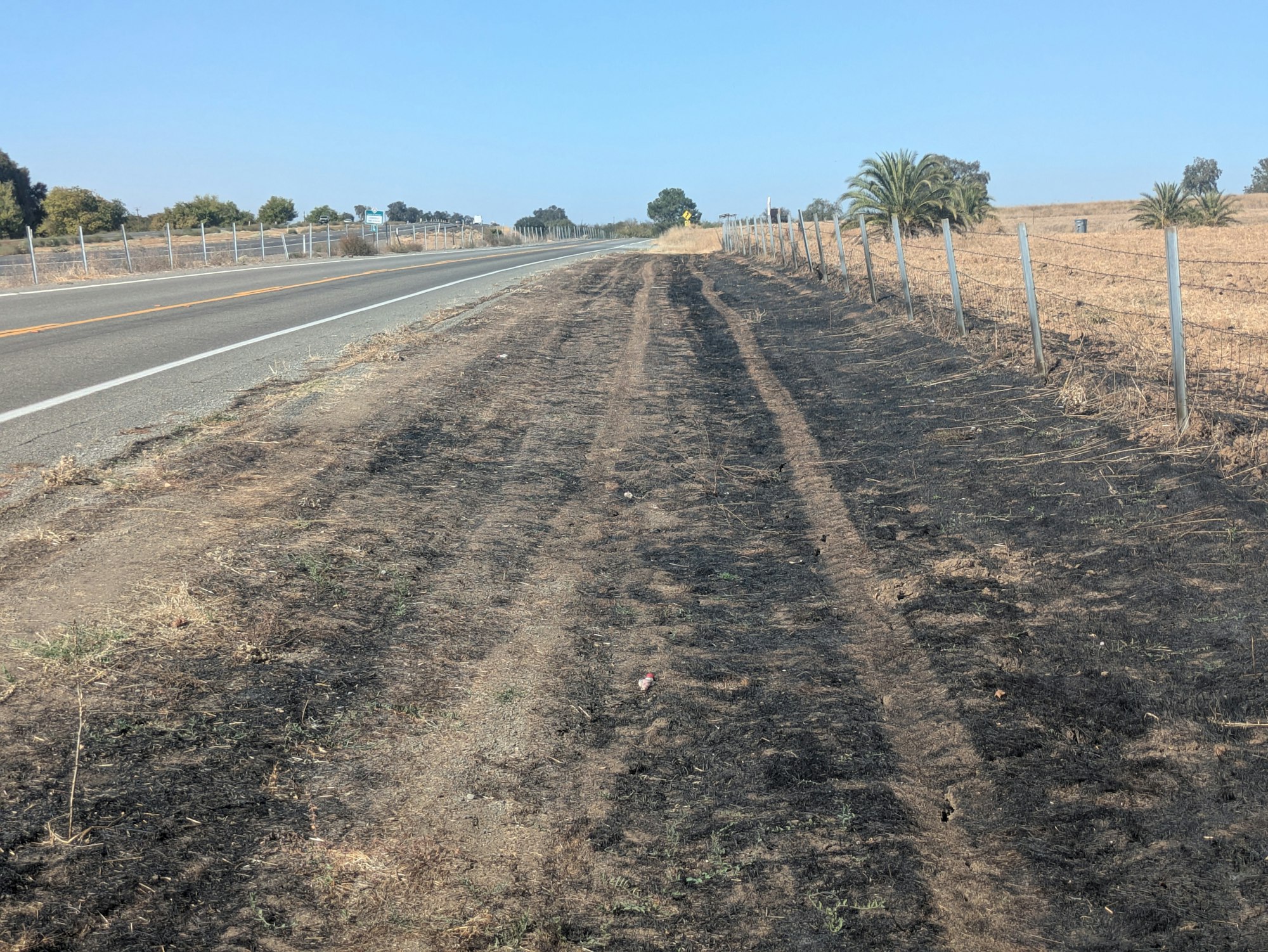
The Solano Prescribed Burn Association (PBA) has been working to expand the use of “good fire” as a tool, which often starts with reminding people that this is a tool we have available. Interested in using fire on your landscape, but not sure where to start – or need some extra hands while burning? The Solano Prescribed Burn Association can assist landowners who want help with using “good fire” as a tool – whether it’s roadside, a back corner of your property, or 100 acres.
Reach out to Elizabeth Davis, SRCD’s PBA lead, for more information: elizabeth.davis@solanorcd.org.
USDA NRCS-
Federal Assistance Opportunities for Ag Producers
The USDA Natural Resources Conservation Service (NRCS) in California announces Fiscal Year (FY) 2027 (October 1, 2026 through September 30, 2027) federal assistance opportunities for agricultural producers.
Apply no later than November 6, 2026
Programs:
Environmental Quality Incentives Program (EQIP)
Conservation Stewardship Program (CSP)
Agricultural Conservation Easement Program (ACEP)
Regional Conservation Partnership Program (RCPP)
To apply for EQIP, CSP, and ACEP
To apply for RCPP:
www.nrcs.usda.gov/programs-initiatives/rcpp-regional-conservation-partnership-program/how-to-apply
Local NRCS Service Center:
810 Vaca Valley Parkway, Suite 104, Vacaville, CA 95688
(707) 448-0106
Board of Directors and Committee Members